Selecting an industrial air compressor that meets your specific needs can significantly impact your facility’s day-to-day performance and long-term efficiency.
Despite their importance, however, compressed air systems continue to be one of the least understood utilities in industrial environments, particularly when compared to more familiar systems such as water, electricity, or gas.
This knowledge gap often leads to poor purchasing decisions, unnecessary costs, and avoidable downtime.
Start With Purpose: Why Do You Need Compressed Air?
The cornerstone of optimal compressor selection starts with a single question: What do you need compressed air for?
Before examining equipment specifications or evaluating suppliers, establishing your specific application needs is crucial. This methodology helps avoid the frequent mistake of choosing equipment based on assumptions instead of verified operational compressed air needs.
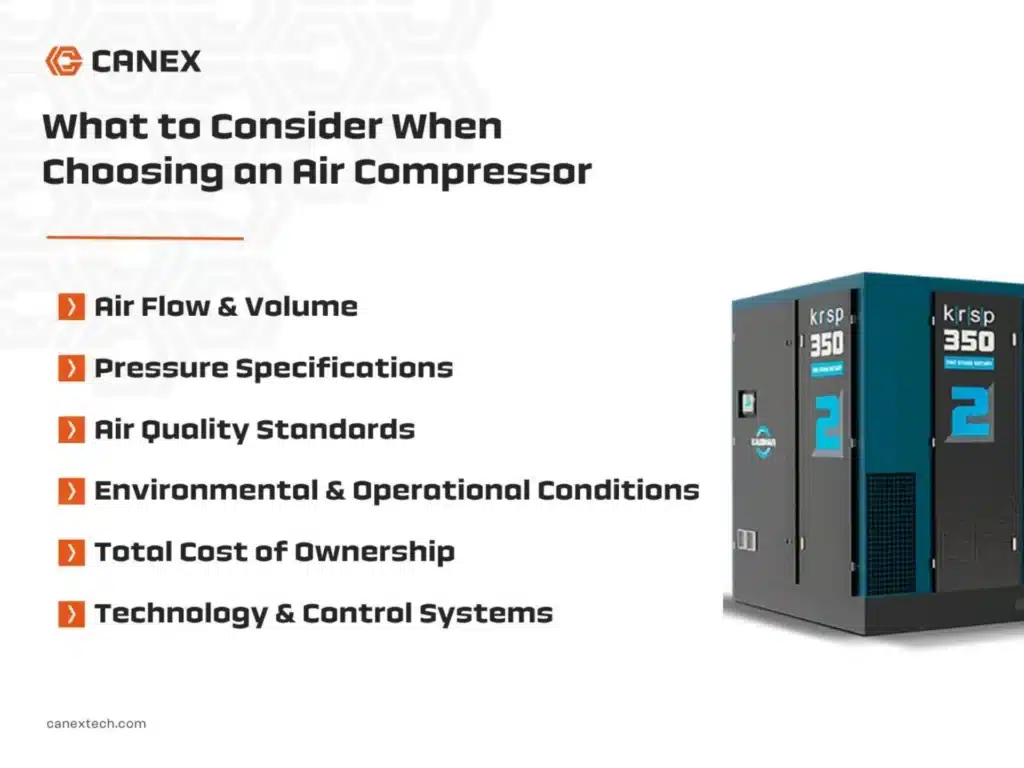
Air Flow Requirements & Volume Capacity
The cornerstone of system planning is your compressed air consumption.
Start by determining the airflow, measured in cubic feet per minute (CFM), required for all operational functions, while accounting for fluctuations in demand throughout your production schedule.
Next, establish whether your applications demand constant air availability or if stored air capacity can handle peak usage periods.
Pressure Requirements
Document the pressure specifications for all your industrial applications.
Each process will demand different pressure levels, and understanding both minimum and maximum air pressure needs helps you prevent expensive oversizing.
However, avoid allowing a single high-pressure application to dictate your complete system specifications when the majority of your facility functions at lower pressures. More efficient solutions exist for managing varying pressure requirements.
Air Quality Standards
While other utilities deliver a consistent standard, compressed air quality must be tailored to your specific requirements.
Thoroughly assess the filtration level, drying requirements, and separation needs your processes demand rather than automatically choosing the most expensive compressor type as a precautionary measure.
Many facilities mistakenly assume they require oil-free compressed air when oil-lubricated systems would function excellently for their industrial operations.
Environmental & Operating Conditions
Your facility’s environment influences equipment selection and long-term performance.
It’s important to record operational temperature ranges, humidity conditions, particulate levels, noise limitations, and available space. Understanding these factors is essential for selecting the most suitable air compressor for your specific industrial environment.
Total Cost of Ownership Analysis
Your air compressor investment goes beyond the initial equipment price.
Consider energy efficiency ratings, operational expenses, maintenance needs, and the projected lifespan of your equipment, as these elements significantly impact your total cost of ownership and investment returns.
Furthermore, investigating government incentives can substantially reduce the upfront costs of more efficient equipment.
Technology & Control System Selection
Proper control technology plays a vital role in the performance and reliability of your industrial compressor.
Variable Frequency Drive (VFD) compressors deliver outstanding energy efficiency in optimal conditions. However, if your facility encounters challenges, including unstable power supply, high altitude, dusty surroundings, or extreme temperatures, VFDs can result in higher maintenance costs and reliability concerns. In such situations, alternative control options, such as spiral valve systems, may offer more appropriate efficiency advantages with reduced complexity.
4 Mistakes to Avoid When Purchasing an Air Compressor
Many common mistakes can be avoided with the right planning and education.
Here are a few that Canex Technologies helps clients identify early in the selection process:
1. Making Assumptions
The most costly mistake companies make is selecting a compressor based on assumptions instead of verified requirements.
As already mentioned, many industrial operations automatically choose oil-free compressors, even when less costly oil-flooded compressors would perform optimally. This decision is often driven by risk avoidance and a limited understanding of operational requirements.
Prior to defaulting to premium alternatives, invest time in determining whether your processes genuinely require the more expensive option or if a more cost-effective solution is available to meet your demands.
2. Oversizing Issues
Without a comprehensive facility evaluation, companies frequently oversize their compressor systems, resulting in increased initial expenses, reduced operational and energy efficiency, excessive maintenance requirements, and inefficient system configurations.
The natural tendency to “purchase larger for safety” can prove counterproductive, even when planning for future growth. Investing time to establish your actual requirements can save thousands in long-term costs while improving overall efficiency.
3. Ignoring Third-Party Verification
Depending on reliable sources ensures you’re making an educated investment rather than a guess.
Without independent validation, performance data may not reflect actual industrial operating conditions. It’s helpful to request independently verified information from your air compressor supplier, such as standardized Compressed Air & Gas Institute datasheets, for accurate comparisons of flow rates, power consumption, and efficiency between manufacturers.
4. Overlooking Regulatory Compliance
Neglecting regulatory requirements can result in delays, penalties, or safety concerns.
In multiple Canadian provinces, end-users are responsible for ensuring all installed equipment complies with provincial regulations. If a vendor’s proposal does not explicitly include required certifications, it likely lacks proper documentation. Therefore, always verify that certifications are clearly stated and included in your air compressor purchase agreement.
Canex Technologies’ Approach to Compressor Selection
At Canex Technologies, we take an education-first approach to industrial air compressor selection because informed decisions lead to better performance, lower lifetime costs, and greater long-term value for your operation.
If you’re replacing outdated equipment, upgrading your facility, or designing a new compressed air system, our team supports you every step of the way.
Discovery & Understanding
We start by learning about your operations, challenges, and future goals. This process involves identifying how compressed air is used across your facility, analyzing current system performance, and uncovering opportunities for improvement.
Strategy Development & System Design
With a clear understanding of your environment, we evaluate different compressor technologies and system configurations. We compare the pros and cons of multiple options to ensure our recommendations are tailored to your actual needs, not just industry averages.
Transparent Recommendations
We provide straightforward, unbiased advice because our goal isn’t to push a particular model. Instead, we focus on presenting solutions that offer the best balance of performance, compliance, and long-term value for your specific operation.
Long-Term Support
Our partnership extends beyond installation. We provide commissioning services to confirm your industrial air compressor performs as anticipated, including monitoring and adjusting settings for optimal performance. Throughout your compressor’s lifecycle, we also deliver maintenance services and genuine OEM components.
Work With Experts Who Understand Industrial Compressed Air Systems
Selecting the best industrial air compressor demands a comprehensive understanding of your operational requirements, a transparent evaluation of available technologies, and a partnership with knowledgeable professionals who prioritize your ongoing success.
With decades of experience supporting industrial clients across Ontario, Canex Technologies is here to help you make an informed, confident investment in your compressed air infrastructure.
Not completing regular maintenance on your industrial pump can decrease its life by 50% or more. Skipping routine pump maintenance doesn’t just shorten equipment life; it accelerates wear on internal components and can turn a minor fix into a major repair bill. A pump that receives consistent, scheduled attention can run reliably for decades. Your […]
Air Compressors are foundational to industrial operations, but like any critical utility, they’re prone to issues that can disrupt production, drive up energy costs, and cause unplanned downtime. The good news is that most compressor problems follow recognizable patterns, and early identification goes a long way toward preventing serious damage. We’ve put together a list […]
It’s no surprise that unexpected compressor downtime can disrupt operations and lead to costly repairs. As a result, two specific questions are often asked across industrial facilities: what is the most common cause of compressor failure, and why do compressors fail even when equipment appears to be operating normally? While multiple issues can contribute to […]